Ga naar hoofdinhoud

The Federal 2025 Coalition Agreement: What does it mean?

posted on 6/2/2025

On Friday, January 31st, a new Belgian federal coalition was formed, known as the Arizona Coalition. This coalition has reached a consensus on a common vision and priorities up to 2029.


While the exact content and timing of this agreement are still to be defined, several key points related to mobility have already been announced, which could significantly impact both businesses and employees. 


This blog provides an overview of the most important changes.

Extension of the transition period for plug-in hybrid vehicles

One of the most notable points in the new agreement is the reduction in the tax deductibility of plug-in hybrid electric vehicles (PHEVs).


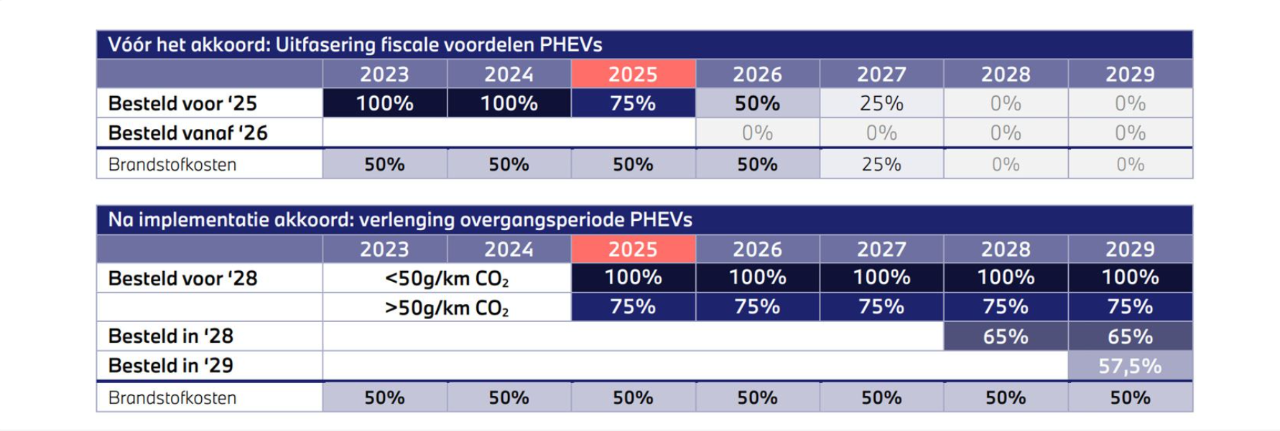
Before the agreement was implemented, the 100% tax deductibility of PHEVs was to be reduced by 25% per year from 2024 onwards.


Under the new agreement, PHEVs ordered before 2028 will remain 75% deductible.


For PHEVs ordered in 2028, the deductibility will be capped at 65%.


PHEVs ordered in 2029 will still be 57.5% deductible.

Important exception


An exception applies to PHEVs with CO2 emissions of less than 50g/km.


If the calculation ‘120% - (0.5% x [coefficient] x CO2)’ results in a score higher than 75%, the car remains 100% deductible until the end of 2027.


Other additions


  • The CO2 contribution is the same as for a fully electric car.
  • Fuel costs remain 50% deductible, electricity costs remain 100% deductible.
  • Benefits in kind: The calculations remain the same. In general, however, high CO2 emissions = high benefit in kind (VVA)!


In 2025, also take into account the implementation of Euro 6b. This means that new PHEVs will fall within the maximum deductibility. As a result, the benefit in kind for drivers will increase significantly.

Changes to the mobility budget

Firstly, companies will be obliged to offer the mobility budget to employees who are entitled to a company car.

Employees can still choose whether or not they want to use the mobility budget.


Secondly, the mobility budget will have to become ‘available to everyone’ over time. This means that employees without (entitlement to) a company car must also be offered the budget.


No exact details have yet been shared regarding timing and scope, but transitional measures will be considered to give companies time to implement the mobility budget.

Other important changes

Social leasing enables employees with insufficient income to lease an electric car. The government will investigate how it can support social leasing of electric vehicles, aimed at employees with an income below a certain threshold. 

Since electric versions of light commercial vehicles and lorries are considered too expensive compared to their fuel alternatives, the government will continue to provide financial incentives for the purchase and use of electric versions. 

The government will investigate the tax deductibility of carpooling to work so that all employees can benefit from carpooling. 

Conclusion

The Federal Coalition Agreement 2025 brings a number of important changes that will affect both businesses and employees. From reducing the tax deductibility of PHEVs to the mandatory introduction of the mobility budget for all employees. These measures are aimed at promoting sustainability and mobility.


The insights in this blog are subject to changes in the timing and content of the coalition agreement.


Related articles & services