Ga naar hoofdinhoud

What is leasing and what are its advantages?

Published on 5/8/2025

You have undoubtedly heard of “leasing”. Leasing is particularly popular in a business context, especially for financing company cars.


But what exactly is leasing? What does it involve? What types of leasing are there? And what are the advantages that make leasing so popular?


Find out in this blog. 

What is leasing?

Leasing is a form of financing that allows companies and individuals to “rent” items or resources from a leasing company.


The leasing company finances what you want to lease and makes it available to you. In exchange, you pay a monthly instalment for its use.


In principle, you can lease almost anything, both for business and private use, such as cars, machines, computers and other business assets.


Alphabet is your partner for leasing company cars and bicycles, as well as other solutions such as the mobility budget.

What types of leasing are there?

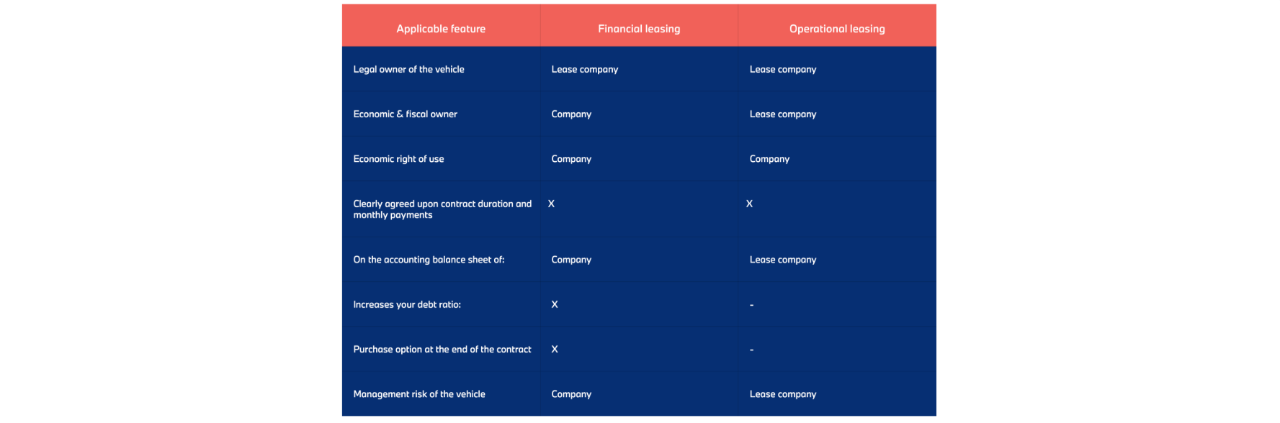
Operational leasing is a leasing formula whereby the leasing company provides a vehicle and takes care of all the mandatory administrative matters (insurance, taxes, duties) and the management of the vehicle. As the lessee, you pay a pre-agreed monthly rate that covers all these costs.


Because the leasing company purchases the car, it remains the property of the leasing company (legal owner) at all times and is included in the company's balance sheet (economic owner).


During the lease period, you as the lessee are granted the rights to use the vehicle (economic user). You can claim the monthly repayments as expenses.


How does operational leasing work?


  1. You choose a leasing company from which you want to lease a company car.
  2. You decide which car you want to lease from the leasing company's range. Each company works with carefully selected suppliers and distributors to put together its range.
  3. You configure the vehicle yourself at a dealer of your chosen brand or using a tool provided by your chosen leasing company. You then send this configuration to your leasing company. They confirm your order and finance the purchase of the vehicle.
  4. You draw up a lease contract together with the leasing company. This contract specifies how long you will lease the car and what your monthly repayment will be. With operational leasing, you can also include additional services such as fuel supply, insurance, tyre changes and more. The additional services you can add depend on the chosen party.
  5. You return the car at the end of the lease period. You can also buy the car if a purchase option was included in your contract, but this is less common in practice.


Due to its all-inclusive nature, operational leasing is by far the most popular form of leasing.  

With financial leasing, you only pay for the use of your company car. Optionally, you can also outsource the administrative matters to the leasing company. However, you are responsible for the management yourself.


With financial leasing, as with operational leasing, the leasing company remains the legal owner of the vehicle. However, the vehicle is listed on the lessee's balance sheet. During the lease period, you, as the lessee, are granted the rights of use of the vehicle (economic owner). The accounting treatment for your company in the case of financial leasing is done via your balance sheet. The latter is disadvantageous for your company as it will increase your debt ratio.


Your lease contract for financial leasing always includes a purchase option. This allows you to take over the car at the end of the lease period. With this type of lease, the residual value of the car may not exceed 15% of the list price.

In addition to leasing, there is also renting, a form of hiring company vehicles.


You can read about what renting is in one of our other blogs.

The advantages of leasing

  • You retain more liquidity because you do not have to purchase the vehicle yourself.
  • You choose which vehicle you lease and which options it includes.
  • You can outsource the administration: this is included in operational leasing and is optional in financial leasing.
  • You only pay part of the VAT: the leasing company pays the invoice for the company car, including VAT, to the supplier. You only pay part of the VAT according to your usage.
  • You can get a tailor-made lease contract: you choose how long you lease the car and which services you include. With financial leasing, you also determine the residual value of the car and your monthly repayment.
  • You can optimise the TCO of your fleet, especially if you opt for electric leasing.

Discover your options at Alphabet