

Rethinking the company car: a strategic imperative
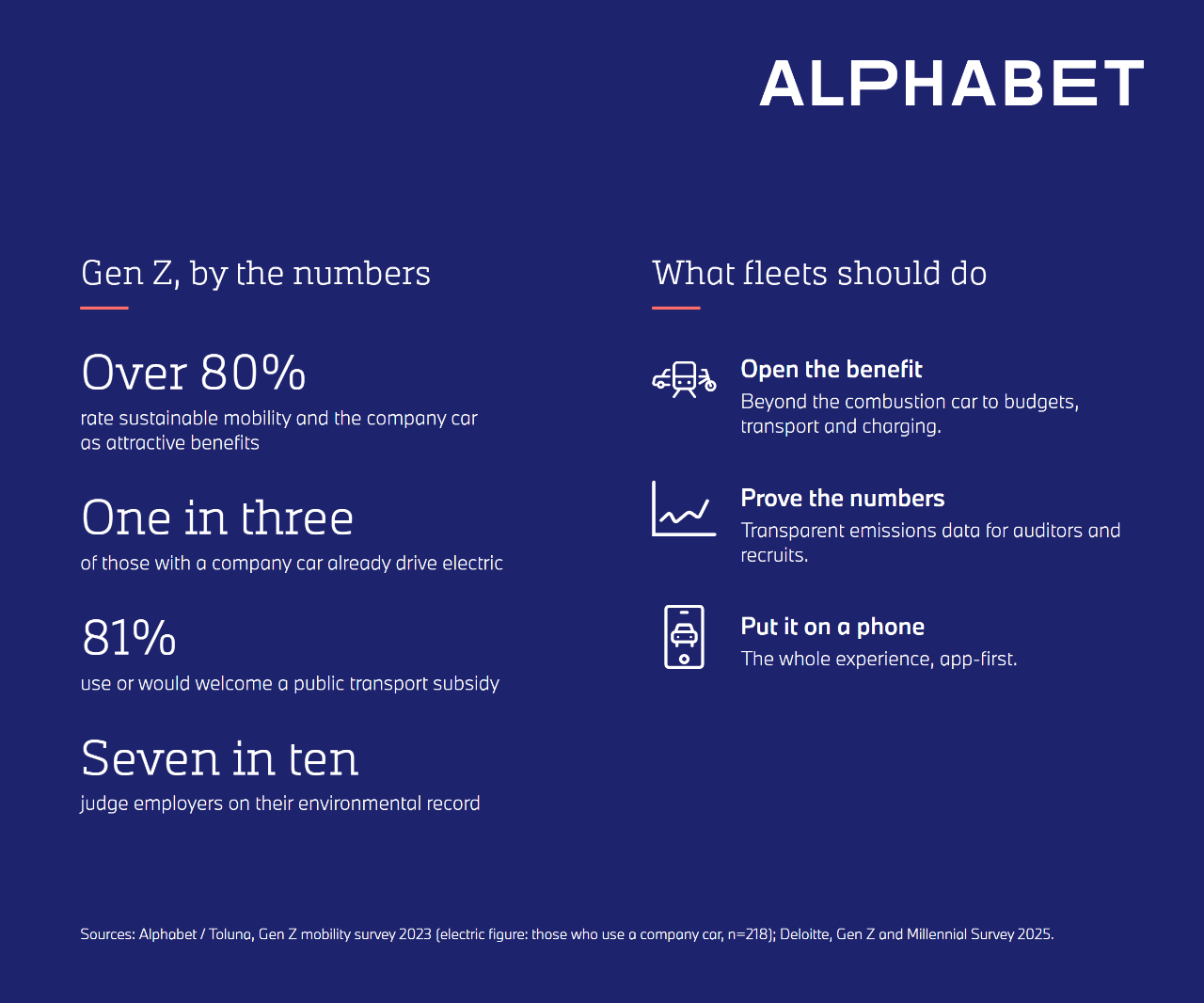
For Gen Z, sustainability is a personal concern that increasingly influences their choice of employer – and it reshapes their expectations for a company car. A representative Alphabet Germany survey found that over 80% rated both sustainable mobility and the company car as attractive benefits1. The perk remains appealing – provided it fits their climate expectations. Generation Z is particularly enthusiastic about electric company cars: more than a third of company-car drivers already use an electric vehicle, and nearly half can envisage doing so in future1.
The appeal goes beyond the vehicle itself. The survey shows that 81% already use, or would welcome, an employer-funded public transport subsidy, and an equal proportion favour a mobility budget they can use across modes. Together, these findings represent a clear departure from the past: the combustion-engine company car – once a status symbol and a discreet retention tool – is yielding to flexibility and lower-emission alternatives.
Clear actions, not claims: what the new workforce demands
This is not only a German story. The same expectations appear across markets, and they matter most when people choose an employer. Gen Z does not accept green claims at face value: across 44 countries, almost a quarter research an employer’s environmental record before taking a role, and seven in ten regard that footprint as a deciding factor2.
For fleet decision-makers, this has become as much a matter of compliance as of values. The EU’s Corporate Sustainability Reporting Directive (CSRD) requires tens of thousands of companies to disclose their environmental impact, including fleet emissions. Two forces now pull in the same direction: regulation demands the figures, and young talent checks them before signing. That makes transparent reporting both a legal duty and a recruiting advantage. And real transparency means owning up to the setbacks as plainly as the successes. That honesty is what separates genuine commitment from greenwashing, and it gives fleet managers the data to report with confidence and build a credible employer brand.
Native digital solutions: the new standard for corporate mobility
Generation Z is the first peer group to have come of age entirely in a digital world; they have witnessed the internet’s rapid development firsthand and woven it into almost every aspect of daily life. This digital fluency shapes how they work and how they move. Engaging this generation requires understanding their preferences and meeting them where they already are: on-screen.
Online solutions also land far more readily with this generation than with Gen X or Baby Boomers3. Convenience means managing everything from a smartphone, and mobility is no exception. For a business mobility provider, meeting that expectation means putting the essentials in the driver's hand: an app to manage bookings, view contracts, locate charging points and complete licence checks, all from a phone. That kind of self-service is precisely what digitally fluent young talent expects.
From principle to practice: the levers that turn mobility into fleet policy
Across markets, expectations converge: lower emissions, transparent reporting and a digital-first experience. So, what should a fleet manager do with this? Quite a lot – the company car is only the starting point. The most forward-thinking fleet policies now extend benefits across modes and incentivise lower-emission choices outright.
In practice, that means a set of complementary levers: mobility allowances drivers can spend as they choose; full or partial reimbursement of public transport passes; on-site charging points; and subsidies for home wallboxes. Some employers go further, rewarding drivers who choose an electric vehicle with an upgraded model. Built into the fleet policy, these measures achieve two goals at once: they reduce emissions and they sharpen the appeal to a workforce that values choice and responsibility.
The fleet agenda: priorities for tomorrow’s talent market
Stripped back, the message is straightforward. The company car has become a talent decision, and the fleet desk now sits at the intersection of cost, compliance and culture. Three actions are now clear:
- extend the benefit beyond the combustion vehicle;
- keep emissions data transparent enough for both auditors and sceptical young recruits;
- and make the entire experience accessible via a smartphone.
The right partner makes each step easier, and that is worth weighing when choosing who to work with. Execute this well and mobility ceases to be merely a line item; it becomes a reason for the next generation to choose you. The future of fleet management will be determined not by the vehicle alone, but by the values and the experience that accompany it. Companies that recognise this today are the ones Gen Z will favour tomorrow.
Sources:
1: Alphabet Fuhrparkmanagement GmbH / Toluna, Anforderungen der Generation Z an die Unternehmensmobilität, 2023.
2: Deloitte, Gen Z and Millennial Survey 2025 (44 countries).
3: McKinsey, Mobility Consumer Pulse Survey 2025.